















It’s 2026, let’s be honest, businesses are no longer asking whether AI will change the workforce.
It already has.
AI agents are answering calls, qualifying leads, analyzing data, and helping companies operate faster than ever before. Studies say that 88% of organizations reported regular AI use in at least one business function.
At the same time, human employees continue to bring judgment, creativity, empathy, leadership, and strategic thinking that machines cannot fully replace.
So the real question is no longer “will AI replace human employees?” it is, “How do you build a workforce where AI and humans work together?
But before we hop onto debating which workforce is more beneficial, let's address what exactly is an AI workforce that every business is building.
And why has it become an absolute need of the hour?
What is the AI Workforce?
An AI workforce is a team of intelligent AI agents designed to support, automate, and optimize business operations.
Why Do Businesses Need An AI Workforce?
The gap has been there since ages. But in 2026, businesses cannot afford disconnected tools, manual follow-ups, delayed reporting, missed leads, or teams buried in admin work.
So businesses built a solution, the AI workforce which works 24/7 across sales, finance, support, rev ops, marketing, and analytics. They don’t only take action but also learn from data, and keep every process moving.
Key benefits of an AI workforce:
- Works 24/7 without delays or downtime
- Reduces repetitive admin work for human teams
- Responds to customers, leads, and internal tasks faster
- Improves accuracy by reducing manual errors
- Keeps data, systems, and workflows connected
- Helps teams make faster and smarter decisions
- Lowers operational costs while improving productivity
- Allows businesses to scale without constantly adding headcount
The real value is not just automation; it is having intelligent systems that can think, act, and execute like an extension of your best team members.
AI vs Human: Let’s Compare The Capabilities of Both!
The debate isn't about replacement, it's about understanding where each workforce delivers its best, so you can build a smarter, leaner, and more competitive business.
1. Performance and Productivity
Let’s start with the most important factor i.e., Productivity.
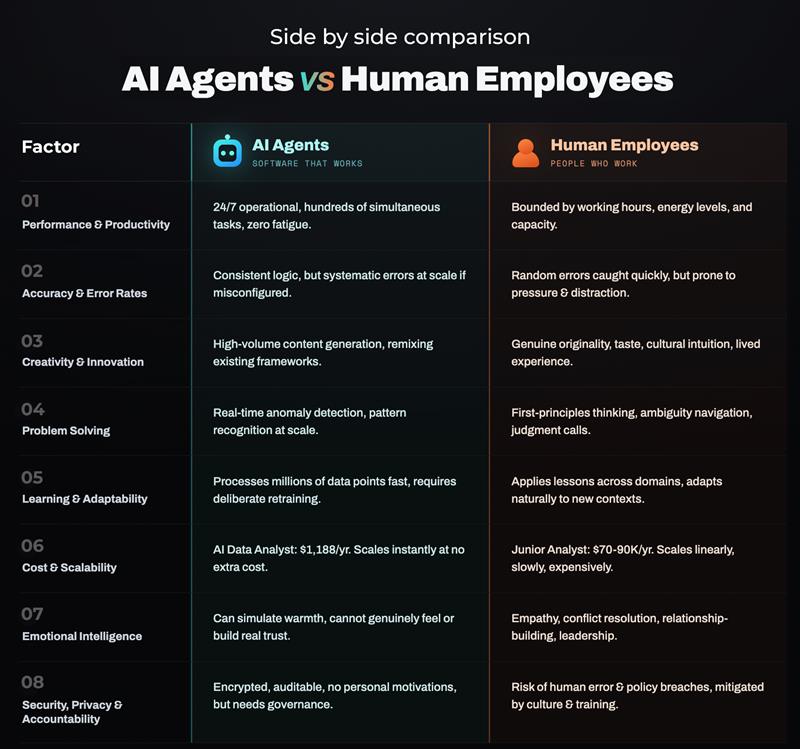
AI agents operate 24/7, without breaks, fatigue, or drop in output quality. A single AI agent can execute literally hundreds of tasks simultaneously. Such as sending emails, updating CRMs, generating reports, and publishing content all at once.
On the contrary, human employees bring contextual judgment and relationship-driven execution. They’re bounded by working hours, energy levels, and capacity limits, due to natural obstacles or limitations.
Studies found AI assistance increased customer support productivity by about 14–15% on average, with the biggest gains for less-experienced workers.
For high-volume and repetitive workflows, AI wins by an order of magnitude. For strategic, relationship-heavy execution, humans remain essential.
2. Accuracy and Error Rates
AI agents are highly consistent but not infallible. They apply the same logic to every task without fatigue or distraction.
But AI agents too make their own kind of mistakes. A poorly written prompt leads to confidently wrong outputs. A data pipeline with bad inputs produces bad analysis at scale. You can get an idea how this works.
On the other hand, humans operate a little differently, the rushed Friday afternoon mistake, the miscalculation under pressure, the step skipped because someone was multitasking, these are all human errors.
The difference is the error profile. Human errors tend to be random and caught quickly through normal workflow. AI errors tend to be systematic, the same mistake repeated at volume until someone intervenes.
Used correctly, with proper guardrails and a human in the loop for edge cases, AI agents significantly reduce overall error rates in high-volume, repetitive tasks.
3. Creativity & Innovation
Humans are the only true source of original thought.
A human creative brings intuition built from years of craft. A copywriter who has worked a decade in an industry knows the current trends, their outputs as well as what the market is tired of hearing before the data proves it.
A designer with an aesthetic design sense can feel when something is off before they can explain why.
Contrarily, AI can produce content at volume. It can generate 50 headline variations in seconds, suggest visual directions, remix existing creative frameworks, and accelerate execution dramatically.
It cannot have a genuine opinion.
The best creative output in 2026 comes from humans who use AI to eliminate the busywork — the resizing, the first drafts, the variations, so they can spend more time on the thinking that only they can do.
4. Problem Solving
AI and humans solve problems in fundamentally different ways.
Humans are unmatched at ambiguous, first-principles problem solving. A seasoned operator walking into a struggling business doesn't need a dashboard to know something is wrong.
Where AI changes the game is in the problems humans are slowest to catch. A human analyst reviewing weekly reports will spot a trend after it has already done damage.
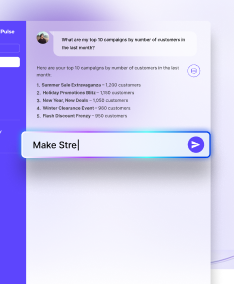
For example, our product Business Pulse AI identifies anomalies in real time, a sudden drop in conversion rate at a specific funnel stage, an unexpected spike in customer acquisition cost from a single channel, a revenue pattern that looks healthy on the surface but signals churn risk underneath.
The result is a problem-solving partnership where AI handles the volume, speed, and pattern recognition that no human team can match at scale.
AI finds the problem early and tells you what the options are. Humans decide which one to take.
5. Learning & adaptability
Humans learn continuously from experience, feedback, and observation and can apply lessons from one domain to a completely different context. The adaptability is not easy to replicate.
Where AI agents are trained on data and require deliberate retraining or prompting to adapt to new conditions.
That said, AI learns within its domain at a speed no human can match, processing millions of data points to surface patterns invisible to the human eye. For adapting to new business contexts, humans adapt faster.
For learning from large datasets, AI isn't comparable.
6. Cost & Scalability
This is where the gap becomes impossible to ignore!
A human marketing coordinator costs $55–75K per year fully loaded. Benefits, PTO, onboarding, management overhead, everything included. An AI Marketing Agent costs $18,000 per year with no benefits, no turnover, and no ramp time.
A junior data analyst runs $70–90K per year. An AI Data Analyst runs $1,188 per year, flat. Beyond cost, AI scales instantly, doubling output requires no additional hiring, no training cycles, no HR involvement.
Human teams scale linearly and slowly.
For businesses between $1M and $30M in revenue, this is the single most compelling reason to deploy AI agents.

7. Emotional Intelligence
Humans hold a clear and significant advantage here.
Empathy, trust-building, reading a room, handling conflict, motivating a team, and navigating sensitive client relationships are deeply human capabilities that AI cannot authentically replicate.
AI can simulate empathy in scripted interactions, a voice agent can be warm and patient but it does not feel, and experienced humans notice the difference in high-stakes moments.
Client relationships, team leadership, complex negotiations, and culture-building remain human territory.
8. Security, Privacy & Accountability
Both AI and humans introduce security risks, just different ones.
Human employees can make compliance errors, leak data unintentionally, or act outside policy under pressure. AI agents operate within defined parameters, with encrypted data handling, full audit trails, and no personal motivations.
The risk with AI is configuration and oversight, a poorly scoped agent can execute at scale in the wrong direction.
The answer in both cases is governance: clear policies, defined access, and accountability structures that cover both human and AI team members.
Bottom line across all 8 factors: AI wins on speed, volume, cost, and consistency. Humans win on creativity, emotional intelligence, adaptability, and judgment. The businesses pulling ahead in 2026 aren't choosing one over the other, they're deploying AI agents to handle execution at scale while their human team focuses on the decisions, relationships, and creative direction that actually require a person.
What AI Agents Excel At?
AI agents excel at everything that requires speed, volume, consistency, and data — executed without fatigue, ego, or distraction.
AI agents are purpose-built for high-frequency, rule-based execution. They send 500 cold emails before your human team finishes their morning standup. They monitor every metric across every channel simultaneously and flag anomalies before they become crises. They answer inbound calls at 2am with the same patience and accuracy as they do at 2pm. They update your CRM after every interaction without being reminded, generate performance reports without being asked, and publish content across six platforms without a single scheduling conflict.
The common thread across everything AI does well is that the task has a defined input, a defined process, and a measurable output. When those three things exist, AI executes faster, cheaper, and more consistently than any human team at any scale.
What Humans Excel At?
Humans excel at everything that requires judgment, empathy, genuine originality, and the kind of contextual intelligence that only comes from lived experience.
A human account manager reads the tension in a client's voice before the client has said anything is wrong. A human strategist looks at a market that everyone else has written off and sees the opening no one else spotted.
The tasks that belong to humans are the ones where the stakes are relational, the situation is genuinely novel, or the decision requires someone to stand behind it with their name and reputation attached.
Why Hybrid Workforce Is The Best Approach?
Simple.
Because the question was never AI or humans. It was always how to get the most out of both.
A fully human workforce in 2026 is leaving an enormous amount of execution capacity, speed, and cost efficiency on the table.
A fully AI workforce is leaving judgment, creativity, trust, and genuine human connection on the table. Neither extreme produces the best outcome, and the businesses winning right now are the ones that have figured out where each belongs.
How Venture AI Helps Businesses Build the Workforce of 2026
Venture AI deploys purpose-built AI agents that integrate directly into your existing stack, run from day one, and are fully managed by our engineering team so you never have to think about the infrastructure behind them.
Six agents are live and deployable within 7 days of contract signing.
🤖 AI Marketing Agent handles your content, video, and campaigns.
🤖AI Lead Generation Agent builds your pipeline.
🤖AI Data Analyst, powered by Business Pulse AI, gives your team conversational access to every metric that matters.
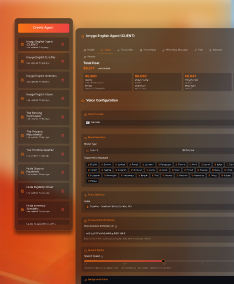
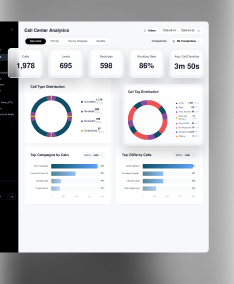
🤖The Voice AI Agent, powered by Convoi.AI, answers every call, books every appointment, and qualifies every lead at $0.25 a minute with no base fee.
🤖AI Productivity Agent clears your team's operational backlog.
🤖AI Sales & CRM Agent keeps your pipeline clean, your follow-ups sent, and your deals moving.
You hire exactly the agents you need. No bundles. No packages. No paying for capabilities you don't use. Start with one agent, see the ROI, and expand from there — each new agent integrates with the ones already running, compounding the output of your entire AI workforce over time.
Your competitors are already hiring AI agents. The question is whether your business will lead that shift or respond to it.
Build Your AI Workforce Today
FAQs For AI vs Human Employees
1. What tasks should AI handle vs. what should humans handle?
If a task is repetitive, data-driven, and has a measurable output, give it to AI. If it requires judgment, relationships, or genuine creativity, keep it human. The cleaner you draw that line, the more productive both sides become.
2. How do you measure success for AI-human collaboration?
Track three things before and after deployment: task volume handled, time your human team spent on that workflow, and output quality.
A successful deployment shows AI absorbing the volume, human time dropping by at least 50%, and quality holding or improving.
3. What organizational changes are required to support a hybrid model?
Less than you'd expect. AI agents plug into the tools your team already uses, Slack, HubSpot, Google Workspace, and more.
The only real shift is cultural: treat AI agents as team members you manage, not tools you operate, and assign a human owner accountable for each agent's output.